Business
When I was fifteen, the marketing director of a large local business asked if I could write the accompanying music for their promotional video. The company designed and manufactured custom automated equipment: complex machines that worked like robots, everything from coin handling devices in vending machines to vast computerised assembly lines. It was my very first commission, and I don't remember anything about the music I wrote. What I do remember is the marketing director taking me to see one of the production lines they had built in a factory that made all different sizes of batteries. I remember because the machinery was impressive, so I knew I had to produce something that sounded equally impressive. I also remember that day because he bought us lunch on the way back; the idea of business expenses really stuck in my head :) He also taught me what a brand was, what it meant, and the importance of consistency in company messaging, whether that messaging be what the company says, how it looks, or how it sounds.
Creativity
So, that is how this company began: that was my first introduction to the branding process and my very first freelance job.
Since all that was more than thirty years ago, I suppose it's obvious that I am not in my twenties and that I'm not running a trendy young startup.
For almost all of the time, since I first wrote music for a business, I have walked two paths: audio design and visual design. I have developed them both simultaneously: designing visual branding (logos, wordmarks, identity systems, etc.), whilst also creating audio branding using sound and music. The two worlds are strongly related and, over the decades, they have informed each other in ways I would never have imagined were possible. This is why I continue to do both. The things that can be learnt from the process of developing visual branding strategies are an important ingredient in being able to create an effective audio identity. Yet, also, an understanding of how music and sound are constructed, and how they communicate emotion, greatly enhances the practice of visual design. I feel that a deep understanding of both of these worlds enables a greater degree of coherence and effectiveness in the branding of any product, service, or company.
Since I started, time has moved on quickly, and technology with it. I began designing visual branding using my hands (pen, paper, paints, and Letraset) because graphically-based computers were simply not available. I began writing music for businesses with a keyboard and a multi-track tape deck. Things have changed a lot. I am grateful for all the technology I have now, but because I began creating sounds, music, and visual designs, all those years ago, I learned that equipment isn't really the source of creativity, neither is a lack of it a limitation.
Very Early Days
Experimentation
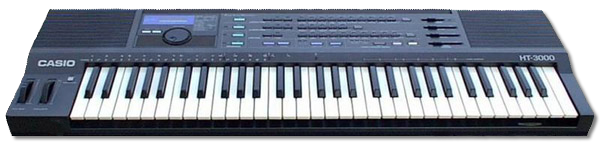
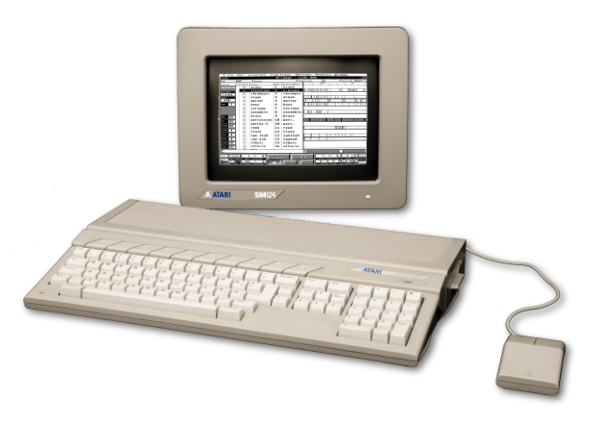
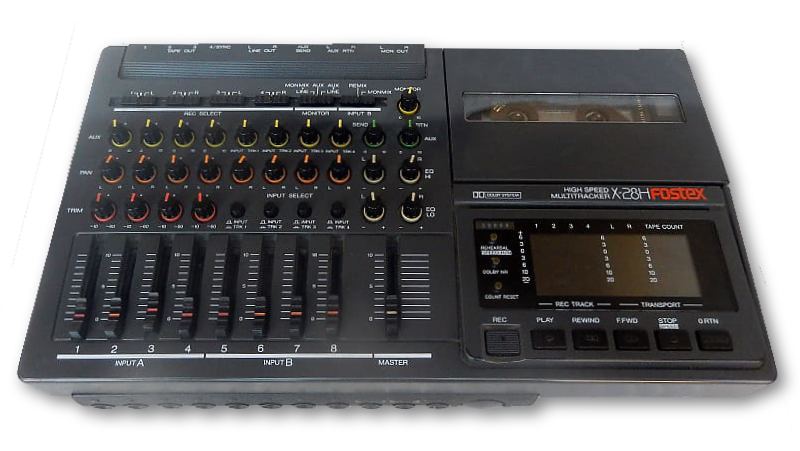
In short, the Casio keyboard, mixing deck, and Atari computer enabled a teenage boy, who could only play a keyboard and clarinet very badly, to layer one sound or instrument on top of another, and then another, and so on. Realistically, this was limited to eight tracks, but with some tweaking and slight loss of quality, even more than eight were possible. My badly played keyboard could synthesize any number of different sounds, from mock recreations of actual instruments to purely synthesized sounds I made myself.
With the X-28H mixing deck, I could record a track with one sound, rewind, and layer another, different, sound over the top. I could record music myself that sounded like an eight-piece band, pan each instrument in the stereo field, mix all the volume levels, even make sounds appear to move around in space.
When I managed to get hold of an Atari ST computer and a piece of software called Cubase, I was able to correct my playing in post-production and write-in notes that played faster than I was physically able to play. A creative world exploded, limited only by my imagination.
When I began writing tunes, I had no real idea of what I was doing. I didn't understand music theory, but I did feel like I knew what sounded right. Music and sounds popped into my head all the time: they still do. I had (and still have) no clue where they come from. At that time I played and I experimented, spending hours and hours locked away trying to recreate in reality the ideas I heard in my head, or just seeing what sounds I could construct with the technology I had.
I still have one of the very first pieces of music I ever wrote. Listening to it now, there are many things I would love to correct, add, even remove. But even though it is, at times, a little painful on the ears, I'm fond of it because it feels like the start of something in my life.
Business
Fortunately, with time, I improved. When I was fifteen, the marketing director of a large local business asked if I could write the accompanying music for their promotional video. The company designed and manufactured custom automated equipment: complex machines that worked like robots, everything from coin handling devices in vending machines to vast computerised assembly lines. It was my very first commission, and I don't remember anything about the music I wrote. What I do remember is the marketing director taking me to see one of the production lines they had built in a factory that made all different sizes of batteries. I remember because the machinery was impressive, so I knew I had to produce something that sounded equally impressive. I also remember that day because he bought us lunch on the way back; the idea of business expenses really stuck in my head :)
Creativity
So, now you know where Resounding began: my first equipment, my first composition, and my first freelance job.
Since all that was more than thirty years ago, I suppose it's obvious that I am not in my twenties and that we're not a trendy young startup. But that's not a bad thing.
For sentimental reasons, I kept the keyboard and mixing deck until just a few years ago. I gave the keyboard to my nephew and the mixing deck to a teenage friend of the family. The only thing I have left from that time is a tiny electronic drum machine in a drawer somewhere in our storage unit.
Time has moved on quickly. I am grateful for all the technology we have now, but because I began creating sounds and music all those years ago, I know that equipment isn't really a limitation to creativity.





























.png)


